

The System Isn’t Broken, It’s Dying
What if the systems we’re trying to fix are actually reaching the end of their life cycle, and leadership is about composting the old while nurturing what comes next?


Photo of A Beautiful Compost Pile by Pablo Merchán Montes on Unsplash
As this work continues to evolve and as Invoke begins to take shape under a new name, Whole Systems Leadership, I find myself thinking more and more about how we relate to systems in transition.
Years ago, I remember listening to Margaret Wheatley speak about cycles of collapse in living systems. She described how we often intervene in systems trying to fix something that appears broken. Yet the system itself is operating in a self-perpetuating way, as if it has a life of its own. What we are trying to repair may not be broken; it may simply be behaving exactly as it was designed.
That idea stuck with me.
It made me think back to my time working in the nonprofit sector. We talked about “fixing the system” constantly. Looking back, though, I struggle to remember many moments where the system itself was actually fixed. If you have any stories of fixed systems, I welcome them!
That being said, we did make incremental differences. We created pockets of thriving, where teams and programs could succeed. We improved conditions for individuals and communities. Yet we ran into structural forces far beyond our circle of control. Competitive funding limited collaboration, and reporting systems pulled attention toward metrics without meaning. Entire programs sometimes had to close because of capacity, shifting priorities, or forces outside the organization’s control.
Often leaders were held accountable for outcomes shaped by systems they had little power to redesign.
Which raises a different question entirely.
What if the system isn’t broken?
What if it’s dying?
Broken systems invite fixes.
Dying systems evoke relationship.
The language we use shapes the story we tell about what is happening. That story shapes how we behave toward it and what results become possible.
If something is broken, the solution is obvious: fix it.
But if something is dying, our relationship to it must change.
Margaret Wheatley and the Berkana Institute illustrate this through what they call the Two Loops Model, which describes how systems rise, mature, decline, and eventually give way to new systems emerging alongside them.¹ New systems rarely appear by repairing the old ones; they grow in parallel, nourished by people experimenting with new ideas, relationships, and ways of organizing. This insight is part of what inspired the work now taking shape as Whole Systems Leadership.
Vanessa Machado de Oliveira extends this insight in her work on hospicing modernity, suggesting that some systems cannot be fixed because they are reaching the limits of their life cycle.² When that happens, the task shifts from repair to something relational: learning how to hospice systems that are ending while also nurturing something new.
When I tell people I’m reading Hospicing Modernity, the reaction is often something like, “That sounds heavy.”
And… Yes, it is an intense book.
But I have also started to notice how quickly we associate death with heaviness, darkness, or negativity. That reaction itself says something about how many of us have been taught to understand life and death as separate things, as if life represents vitality and growth while death represents failure or loss. I think this is a problem.
In many ecological and cultural traditions, that separation simply does not exist. Even in my ancestral Gaelic culture, liminality - the in-between time - has been understood as a time of possibility.
Death carries grief, yes. Times of transition can absolutely be painful. Yet death is also deeply intertwined with renewal.
Hospicing something is not only an act of letting go; it can also be an act of care, reflection, and meaning-making.
It invites us to ask questions like:
What was life-giving here?
What deserves gratitude?
What wisdom can we carry forward?
How might what comes next be nurtured by what was?
Even systems we may now have complicated relationships with (eg. modernity, capitalism, institutional structures) have shaped the world we inhabit and the lives we have lived.
Hospicing them can involve grief.
But it can also involve appreciation; even joy.
The joy of recognizing the life force that once existed there, and the possibility that something new may grow from what remains.
Compost Changes the Way You See Things
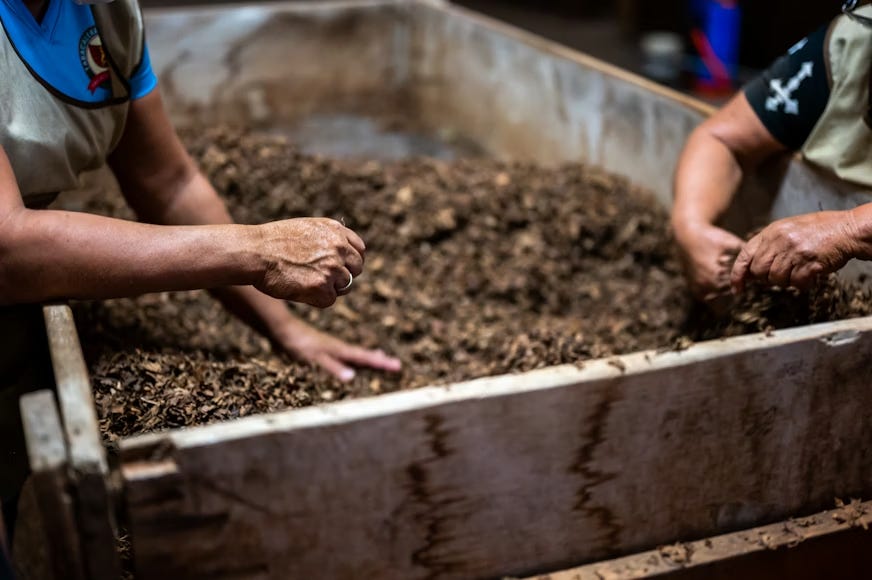
Photo of Rich Soil by THLT LCX on Unsplash
Over the past few years my relationship with these ideas has become surprisingly literal.
On our property in Calgary, and again at Hawthorn Eco Retreat, we began building compost systems. What started as a practical way to reduce waste gradually changed how I think about cycles of life and decay.
Eggshells, vegetable scraps, coffee grounds, the things we once saw as garbage, began to look different.
Now I sometimes catch myself looking at eggshells and imagining future tomatoes. Or even better, imagining those tomatoes becoming one of Sam’s curries.
We get excited when the compost piles heat up. We get excited when the city’s compost giveaway day arrives, because richer soil means healthier gardens. We get excited when worms appear; they signal the soil is thriving.
Compost piles are not places where life ends; they are places where life is transformed.
Compost systems are often among the most biologically active environments you can find. Beneath the surface, billions of microorganisms, fungi, and insects are breaking down what once was into the nutrients needed for what will come next.
Compost does not happen by pretending nothing is decaying.
It happens through the intentional breaking down of what has reached the end of its form.
Sometimes that process is messy; sometimes it smells (though usually that’s a sign to intervene and get more involved); sometimes it takes longer than we would like.
Yet when tended carefully, it creates the conditions for extraordinary fertility.
What if we understood some of the systems around us the same way?
Our Fear of Endings
In modern industrialized societies, we are practiced in resisting this cycle.
Science fiction returns to this theme again and again. The characters who seek immortality often believe they are preserving something valuable; the result, however, is rarely vitality. More often it leads to stagnation, distortion, or unintended harm elsewhere in the system.
Organizations sometimes behave in similar ways.
When systems begin to decay our instinct is often to double down on repair. We write new strategic plans; we restructure; we introduce new metrics and frameworks; we redesign structures.
Some of these practices are useful.
But sometimes they are attempts to stabilize systems that are already reaching the end of their life cycle.
Our discomfort with dying systems may say less about the systems themselves and more about our cultural discomfort with death.
What might become possible for us if we collectively increased our capacity to be with what is ending?
The Neutral Zone
William Bridges’ work on Managing Transitions offers a lens I’ve found to be helpful.³
He describes transitions unfolding in three phases:
Ending
Neutral Zone
New Beginning
Importantly, these phases are not clean or sequential. Bridges notes, “you are likely to be in more than one of these phases at the same time… movement through transition is marked by a change in the dominance of one phase over the others.”
The phase we often struggle with most is the middle one, the Neutral Zone.
This is the in-between space where the old system has begun to break down but the new one has not yet fully emerged. Familiar structures fade; roles and identities feel less certain; productivity may dip.
This place has been described as a psychological wilderness. What makes this phase so difficult is that we rarely have a clear picture of what comes next.
It can feel like the end of a relationship without knowing what the next chapter of life might look like, or leaving a job without a clear sense of what work will follow. The old structure is gone, yet the new one has not taken form.
Our cultural instinct is often to rush past this phase as quickly as possible. Organizations frequently try to skip the Neutral Zone altogether, announcing new strategies, structures, or goals in hopes of restoring clarity and momentum.
But psychologically, people are rarely ready to inhabit a new beginning that quickly.
Bridges suggests that this impulse to rush forward often causes leaders to mismanage the most important phase of transition.
The Neutral Zone may be uncomfortable, but it is also profoundly generative.
When the old system loosens and the new one has not yet solidified, creativity and innovation become possible. People begin experimenting with new ways of working, relating, and organizing.
In ecological terms, this stage looks, to me, a lot like compost. Granted, it may seem gross to some, but depending on your perspective, rich new life is taking shape.
Leadership in this phase is less about eliminating uncertainty and more about helping people move through it. Acknowledging the ambiguity rather than pretending clarity exists. Creating temporary structures that provide enough stability for people to keep moving.
For those wondering what temporary structures might look like, of course it varies greatly and is context dependent. But in practice, it might mean making leadership more fluid, dispersing roles, or revisiting roles and responsibilities regularly, sometimes even rotating them.
It might mean treating decisions, policies, or processes as “good enough for now,” naming them as works in progress, and setting moments to revisit and adapt them.
More than anything, temporary structures are less about getting it right and more about creating enough stability for people to move, learn, and experiment together.
What Leadership Looks Like in a Dying System
If we begin to see systems through this lens, leadership looks different.
Many leaders are trained (and/or expected) to provide clarity and direction. But in moments of deep transition, leadership most fundamentally requires courage to acknowledge uncertainty while helping people remain grounded enough to keep moving together.
Leadership in times of systemic transition is not about having the map; it’s helping people stay present when the map no longer accurately shows the way.
Leaders might begin asking different questions and embracing new challenges:
Stop trying to fix everything: Not every breakdown is a failure; some breakdowns signal that a system has reached the limits of its form. This act may require both active and passive resistance. Sometimes that resistance happens through direct intervention or decision-making; other times it takes the form of reframing assumptions, shifting conversations, or refusing to reinforce patterns that sustain the system as it is. It may also mean resisting the pressure to manufacture certainty while helping create conditions where people can experiment without fear that learning will be held against them.
Compost outdated practices: Some familiar organizational rituals (eg. strategic plans, reporting cycles, performative collaboration structures) may need permission to break down. Instead of discarding past practices entirely, we can ask what wisdom or lessons still have life within them, allowing their ending to create space for new possibilities.
Incubate the new: The next system emerges through small experiments, informal networks, and relationships operating differently from the dominant structure. Remind teams that we are in an in-between time and co-create conditions where experiments are safe to fail. When people know their learning will not be held against them, they are far more willing to try something new. Tell stories of what’s possible and lean into the act of visioning a different future. Use your imagination at work, remembering this is indeed core to our work.
Build sense-making communities: Perhaps most importantly, leadership becomes less about having answers and more about helping people make meaning together in uncertain times. Develop a tolerance for not having answers. Part of the work is helping people stay grounded enough to keep moving forward even when the path ahead remains unclear.
In many cases, this means seeking support beyond a single team or organization: working with communities of practice or organizations like Whole Systems Leadership who are learning how leadership evolves in times of systemic transition.
We may not be able to change the conditions of the larger systems we are operating within.
We can change how we meet them.
We can cultivate environments where people metabolize grief, imagine new possibilities, and build resilience together as we step into the unknown.
Living systems change slowly over time, and sometimes all at once.
Let us learn to recognize when that shift is already underway.
References
Margaret Wheatley & Deborah Frieze, The Two Loops Model
Vanessa Machado de Oliveira, Hospicing Modernity
William Bridges, Managing Transitions: Making the Most of Change
Thanks for bringing this all together in this article. There’s hope!